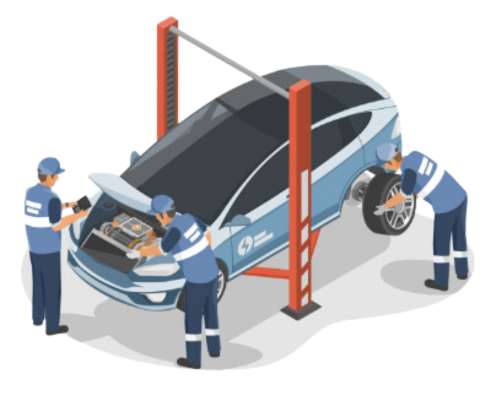
EV Service Technician

Duration: 3 Months
Eligibility:

  • The course is open to both male and female candidates.
  • Age limit: 16-30 years.
  • Minimum mandatory requirement: 10th standard passed.
  • 12th standard passed (any stream).
  • 12th + ITI.
  • Graduates or those pursuing a graduation course.

This course gives an overview of the key topics on E-Mobility. Trainees will get a better idea of what the EV space is all about, after completing the EV Foundation Course.

EV Service Technician Course

Benefit to Industry:

  • Industry is facing a shortage of skilled workers in the EV sector. This gap can be filled with candidates completing this course.
  • Candidates will enter the industry with relevant knowledge gained at a state of the art training facility.

Benefit to Trainees:

  • Trainees are equipped with the requisite technical skills to make them employable in the EV sector.
  • The E-Mobility space is always in need of skilled personnel. Trainees have a very good chance at starting a fruitful career.
  • Trainees can also explore entrepreneurial options in the EV space

Course Content:

  • What is electricity.
  • Advantages, hazards involved.
  • Voltage, current, resistance.
  • Earthing and earth fault protection devices.
  • Short circuit and short circuit protection devices.
  • Key safety points while working with high voltage in electric vehicles.
  • Atomic structure.
  • Energy levels and energy bands.
  • Classification of materials into conductors, insulators and semiconductors.
  • ac, DC, 3-phase ac.
  • Wires and their types
  • Resistor.
  • Capacitor.
  • Inductor.
  • Multimeter.
  • Power supply.
  • Resistances in series.
  • Resistances in parallel.
  • Introduction to magnetic effect of electric current.
  • Introduction to electromagnetic induction, where are its applications.
  • Overview of transformers.
  • P and n-type semiconductors.
  • Diodes.
  • Transistors.
  • Dos and don’ts to ensure secure solder joints and crimps..
  • DC-DC converters: buck, boost, buck-boost.
  • Rectifiers: Half wave, full wave/bridge.
  • Inverters: Half bridge, full-bridge/H-bridge
  • Differences between EVs and ICE vehicles.
  • Hybrid vehicles and their types- series, parallel, series-parallel, mild etc.
  • Basic flow of a pure EV.
  • Lead-acid battery construction and working.
  • Lithium-ion battery construction and working.
  • Cell geometries.
  • Battery safety, tests performed on batteries.
  • Basic working principle of motors.
  • DC motors- PMDC, wound stator.
  • ac motors- asynchronous/induction, synchronous motors- PMSM, BLDC etc.
  • Hall-effect sensors.
  • Working of motor controllers.
  • VCU vs MCU differences.
  • Regenerative braking and other frictionless braking methods in EV
  • What is a transmission.
  • How does a manual transmission system work.
  • What kind of transmission is used in EV.
  • Different sections in the EV electrical powertrain- PDU, OBC, DC-DC converter etc.
  • Energy flow during charging and discharging.
  • Charging standards followed around the world.
  • Overview of differences between analog and digital electronics.
  • Advantages and disadvantages of digital systems.
  • Digital communication- advantages and disadvantages.
  • Digital communication protocols followed for vehicles- CAN bus, LIN bus etc.
  • Fuses- what are they, conventional fuses vs EV fuses.
  • Overview of different connectors and glands used in EV.
  • Relays, DC contactors, their use in EV and ICE vehicles.
  • Different sensors used in EV such as temperature sensors, EPS sensors, wheel speed sensors etc.
  • What are microcontrollers and their role in modern automobiles.
  • Common issues faced in EV and how to troubleshoot them.
  • Use of on-board diagnostics (OBD) tool (vehicle scanner).

ENQUIRY